Getting Started with Trinity · Chapter 10 of 15
What customers will do
Our support inbox answers hundreds of customer emails a week for our own store. Here is what they ask, with the numbers on how often each turns into money.
"Do you have a discount code?"
Constant. The same shopper will ask for a code, then for $50 off, then complain about a card fee, then ask you to honor the price he saw yesterday. Our standing answer: we are a wholesaler, our prices are set as low as we can and stay in business, and the price on the site is the price. Concessions are the owner's call, never a reply template's. A shopper who was going to buy usually buys anyway.
Email for price and offers
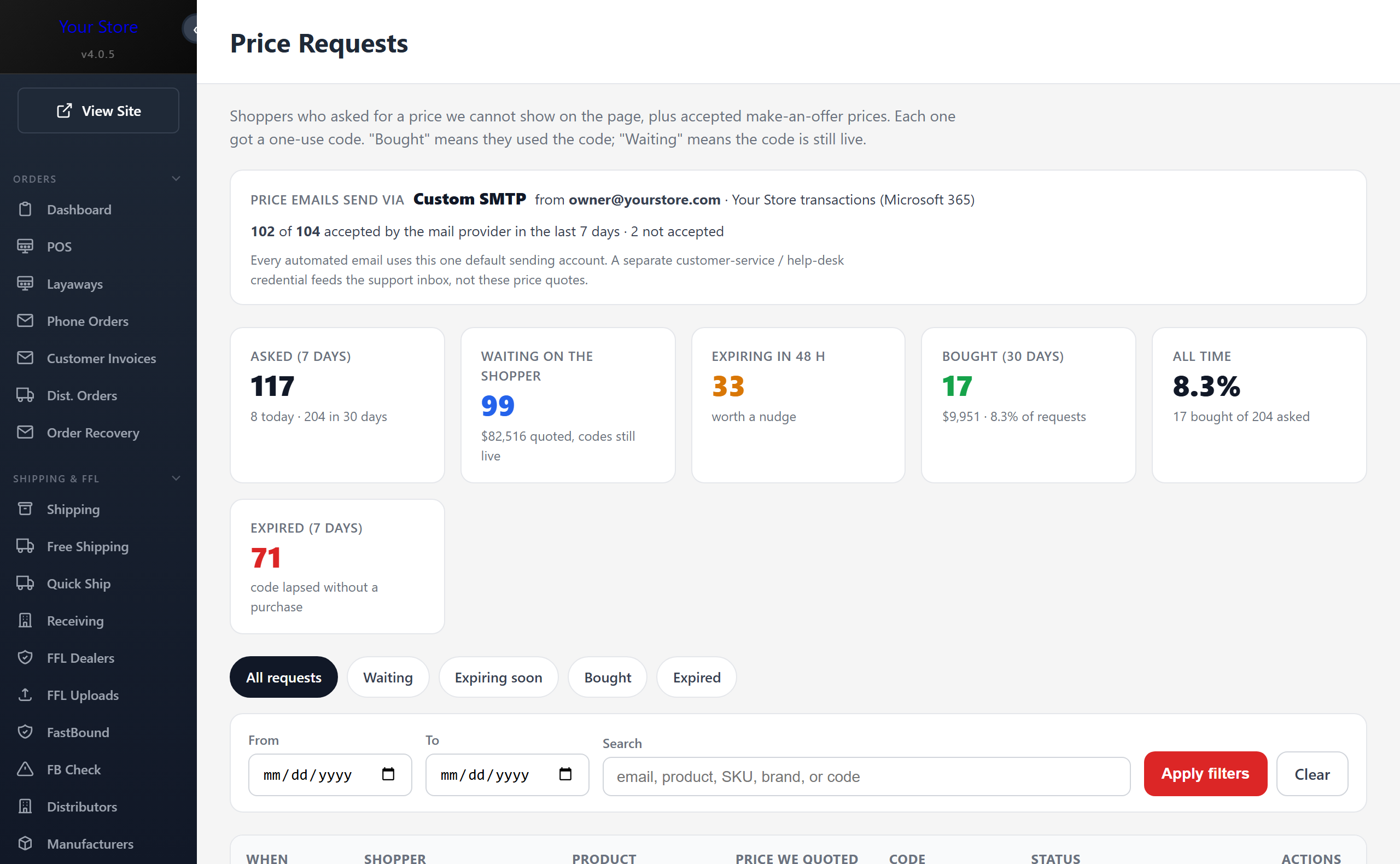
On MAP brands that require it, the product page says "Email for price". The customer enters an email, and the store sends a private quote with a one time code that loads the cart at that price. On our own store 2,297 people asked for a price or made an offer in 90 days and 87 bought (3.8 percent). On the firearms only dealer, 2,266 asked and 147 bought (6.5 percent). On two smaller stores it was 8 and 10 percent. It is a small number of real buyers, and it costs nothing.
The product page also takes offers. An offer at or above your minimum goes into the cart at that price; a lower one is declined, and every offer shows on the Price Requests page. 352 offers came in on our own store in 90 days.
Abandoned carts
When a shopper types an email at checkout and leaves, the store sends a recovery email, then a second one. Our own store sent 921 in 90 days and 20 came back (2.2 percent). The dealer with the most traffic sent 1,117 and 10 came back. Most shoppers who leave never typed an email, so the real fix is upstream: price and shipping. The timing and wording of the recovery emails live under Cart Recovery.
The FFL step
Nearly half of website orders on a full catalog store need a transfer. The customer picks a dealer at checkout from the ATF's list of licensed dealers, or types their own. The customer gets an email with a secure link to upload the license, and so does their dealer when we have the dealer's address. It lands in FFL Uploads in your admin for a quick look, or you attach it on the order page yourself. Until it is on file the order waits in Awaiting FFL, and when the order goes to the distributor the license goes with it. Firearms only dealers see this on every order; it is routine.
Do not wait for the license to secure the gun. A paid order goes to the distributor right away, before the customer's FFL copy arrives, so the gun is on hold for you while it is still in stock. That matters: a popular gun can sell out at the distributor in the hours it takes a transfer dealer to answer an email. The distributor holds it until the license is on file. When the license arrives after the order was placed, send it to your rep against that order number; your rep will usually email you if they are waiting on it. If the license never comes, the order is cancelled with the distributor and refunded. Never place a second order for the same gun because the first one is waiting on paperwork: that buys a gun you did not sell.
Cancellations and refunds
About 10 to 12 percent of orders end up cancelled or refunded across the fleet: cards declined after the fact, customers who change their mind, an item that sold out between the order and the pull, a transfer dealer who will not accept the gun. Card refunds take a few days to show. A firearm that has been transferred is final; the customer deals with the manufacturer.
Phones
Six of ten visitors from the comparison sites are on a phone. Test your own checkout on a phone before you launch and every time you change it.