
Getting Started with Trinity · Chapter 4 of 15
Setting your prices
Online, the shopper sees your price next to twenty other stores' prices for the same item, on the same page, sorted low to high. That is the whole business. A store that is 10 percent above the field is invisible on gun.deals and WikiArms, and when it does get a click, the shopper has already seen a cheaper price.
How a price is made
Every item's price is its lowest in stock distributor cost plus your markup. Markups live on the Pricing page as price tiers: a percent and an optional dollar amount for each cost range. On top of the tiers you can add a category markup, a brand markup and a per distributor fee. The price is then rounded to your price ending, and MAP applies last, so a price never shows below MAP. See Set your markups and price tiers: the Pricing page.
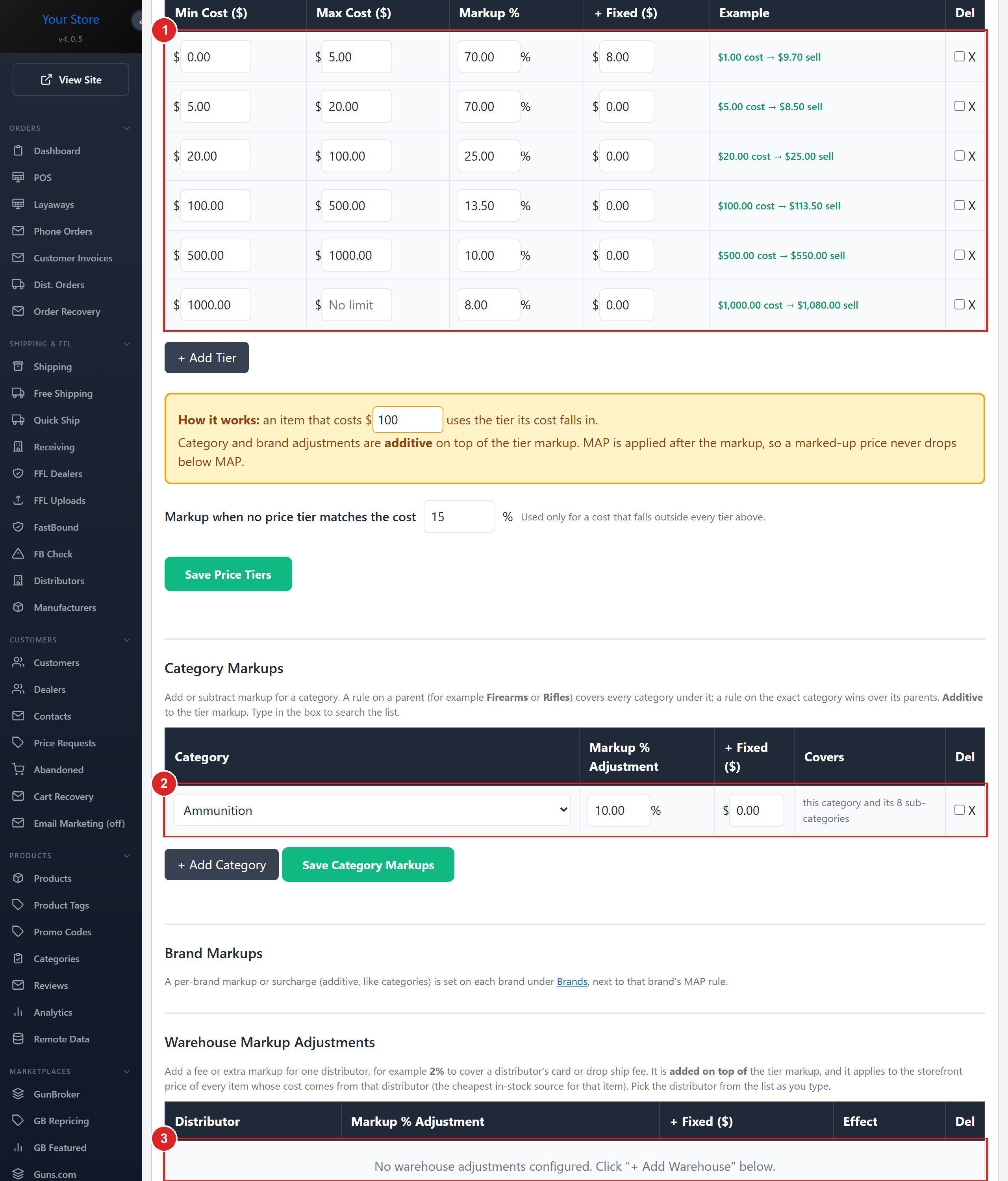
- 1Price tiers: the percent (and optional dollars) over distributor cost for each cost range
- 2Category markups, added on top of the tiers
- 3Per distributor adjustments, for distributors that charge you fees
What the stores that sell actually charge
These are real tiers from stores on Trinity, as percent over distributor cost.
| Cost range | Our own store | The new store, after its cut | The firearms only drop shipper | A store with few web orders |
|---|---|---|---|---|
| Under $20 | 45 to 60% | 75% | cost + $5, minus up to 26% | 35 to 50% |
| $20 to $100 | 25 to 30% | 35% | cost + $5, minus 12 to 26% | 25% |
| $100 to $500 | 11 to 14% | 7.5% | cost + $5, minus 1 to 10% | 18% |
| $500 to $1,000 | 8 to 8.5% | 7.5% | cost + $5, minus up to 2% | 15% |
| Over $1,000 | 7.5 to 8% | 9.5% | cost + $5, about even to plus 2.6% | 12% |
Read that middle column carefully. The firearms only dealer sells most guns at or below what the distributor charges him, plus $5, and makes his money on per distributor fees, volume and a flat shipping charge that covers the real cost. He takes about 57 orders a day. We are not telling you to copy him. We are telling you he exists, and that the shopper comparing prices sees him next to you.
Our own store sits between. On a $600 pistol we are roughly $50 above that dealer and we take about one third as many web orders per visitor. Both are a living. The fourth column is the store with the fewest web orders in the fleet. It is also the store with the highest shipping, and it never got listed on gun.deals.
The lesson from the new store
A dealer launched in early October with markups of 20.5 percent on $100 to $500 and 14.5 percent on $500 to $1,000, and trimmed them to 15.5 and 11.5 a week later. On the same items his prices were still above the other stores, and the price comparison sites ranked him accordingly. He took 11 orders in his first eight days, 1.4 a day, with plenty of visitors. Then he set those tiers to 7.5 percent. Over the next 12 days he took 98 orders, 8.2 a day.
Rules of thumb
- Every store in the table runs its lowest percentages on its most expensive items and its highest on the cheapest: 8 percent on a $1,500 rifle is $120, and 60 percent on a $5 part is $3.
- Check yourself against gun.deals before you launch. Search three guns you stock and see where your price lands; that page is what your shoppers see.
- Different items can carry different tables. Trinity lets you price firearms, accessories, ammunition, in store stock and drop ship items on separate profiles. See Price firearms, accessories and ammo differently.
- Your margins also come from shipping, the card fee if you charge one, and the marketplaces' different fee loads. Think of the whole order, not the markup alone.
- Change one thing, wait a week, read the numbers. Pricing is a dial.
MAP: minimum advertised price
Nearly 700 brands on the platform carry a MAP rule. Trinity never shows a price below MAP on your site, in your feeds or on GunBroker. For brands that require it, the site shows "Email for price" instead of a number, and the customer gets a private quote by email. MAP governs what you advertise, not what you sell: a privately emailed price can be below MAP, and the dealers use that every day.
What to expect: manufacturers run software that reads gun.deals and your product pages. If a number below MAP appears anywhere, even for an hour, you get a notice by email with the UPC, the MAP price list and the policy. Typical terms give you one business day to fix an online listing or two weeks on the brand's Do Not Sell list; repeat violations run to 180 days or permanent. We have had one ourselves, on a rifle whose MAP value was missing from the feed data; the fix took an hour. The chapter on MAP notices covers what to do.